
How Much Sod Do I Need? Measuring Your Tampa Bay Yard the Right Way
How much sod do I need? Measure your Tampa Bay yard the way our crews do: rectangles, deductions, a waste factor, then pallets.
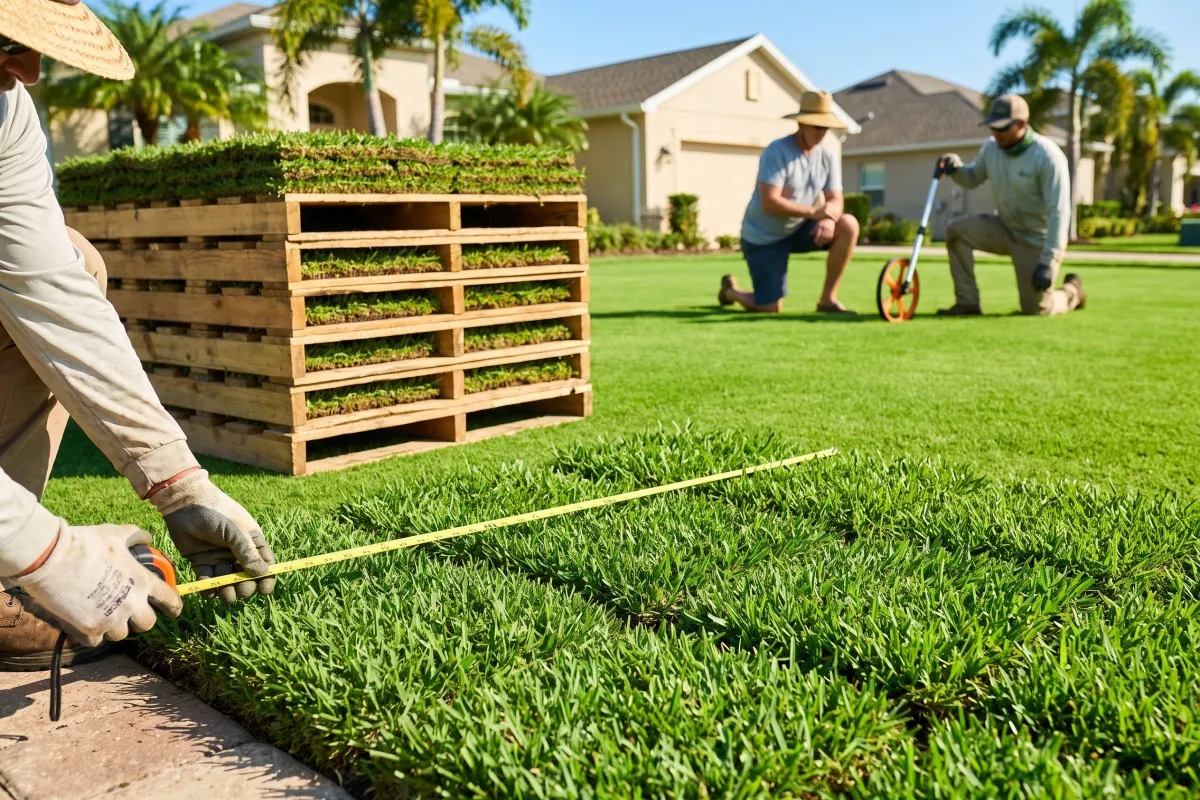
How much sod do I need? Measure your lawn area in square feet, deduct the beds and hard surfaces, then add 5 to 10 percent for the pieces you will cut and throw away. That final number is what you order. Guess instead, and you either pay for a second half-pallet delivery or watch good sod dry out in the driveway. This is the exact geometry our crews run on Hillsborough and Manatee County job sites, written so you can do it yourself before you place an order.
We wrote it because the single most common ordering mistake we see is a homeowner who eyeballed the yard and came up short. Coming up short is the expensive miss. A second delivery costs another trip fee and a day of delay, and the fresh-cut sod you laid on day one keeps aging while you wait.
How much sod do I need? Start by measuring, not guessing
Sod is sold by the square foot, so every good order starts with an honest measurement of your lawn. Grab a measuring wheel or a long tape, plus a pad and a pen. A wheel beats a tape on long runs. You leapfrog a tape across the yard and lose count halfway.
Do not measure the whole lot. Measure only the ground that will actually be grassed. Your house footprint, the driveway, the patio, the pool cage, and the mulch beds all come out of the total. What is left, the open turf area, is the number we are after.
If you would rather let a tool do the arithmetic, a sod calculator for Florida yards will take your length and width and return square feet and pallets. We still recommend sketching and measuring by hand first, because a calculator is only as good as the dimensions you feed it.
Break the yard into rectangles
Here is the trick a crew uses to size an oddly shaped yard in a few minutes. Almost any lawn, no matter how curvy the borders look, breaks down into a handful of rectangles (Bethel Farms). You do not need one clean shape. You need several simple ones.
Walk the property and mentally slice the turf into boxes. The front lawn is usually one big rectangle, the side yard a long skinny one, and the back is often two or three boxes butted together where the patio and fence cut the space up. Sketch it rough, one box at a time. It need not be pretty.
Then measure each box and multiply length by width:
- A front lawn 40 feet wide by 25 feet deep is 1,000 square feet.
- A side yard 12 feet by 60 feet is 720 square feet.
- A back section 30 feet by 35 feet is 1,050 square feet.
Add the boxes together for your raw turf area. In that example, 2,770 square feet before any adjustments. Round each measurement up to the nearest foot as you go (Tri-Turf Sod Farms). A small buffer on every box is cheap insurance against coming up short.
For a rounded flowerbed or a curved lawn edge, drop a rectangle over the widest part of the shape and measure that. You will overshoot slightly, which is fine here. That overshoot becomes part of the cushion you want anyway.
Deduct the beds, tree rings, and hardscape
Now take out the ground that will never hold grass. This is where careful measuring saves real money, because these deductions can be large. A single mulched bed running the front of the house is easily 100 square feet gone.
Measure each non-turf island the same rectangle way and subtract it. Planting beds, the mulch ring around each oak, the AC pad, stepping-stone paths, the shed footprint. A screened pool cage can swallow another 400 to 600 square feet on its own. On the yards we walk across Brandon and Apollo Beach, a mature front yard with established beds and two or three tree rings can shed 15 to 20 percent of its raw area once you pull the islands out.
One judgment call worth making up front: pick the right grass for each zone while you are measuring. A strip under a dense live oak needs a shade-tolerant variety, not the same sun-loving turf as the open front. Our project managers map sun, shade, slope, and foot traffic before anyone orders, and you can preview those trade-offs in our sod variety comparison guide.
Add a 5 to 10 percent waste factor
Your lawn is not made of rectangles, but sod is. Every piece comes as a clean rectangle, and your yard has curves, angles, beds, and obstacles that force you to cut pieces to fit. The trimmed-off scraps usually cannot be reused, so a measured order that hits your square footage exactly will still leave you short. That gap is the waste factor.
How much to add depends on your yard’s shape (All American Sod):
- Add about 5 percent for a simple, mostly rectangular yard with straight, clean edges.
- Add about 10 percent for curved borders, slopes, garden-bed cutouts, and lots of trimming around obstacles.
- Go to 15 percent for a genuinely complex yard: steep grades and tight islands everywhere.
Most Tampa Bay lawns land at 10 percent. Take that 2,770-square-foot example, subtract roughly 400 square feet of beds and tree rings, and you are near 2,370 square feet of turf. Add 10 percent for cuts and you order for about 2,610 square feet. That is the number that gets you a finished lawn with no bare gaps at the edges and no frantic call for more sod at 3 p.m.
Turn square feet into pallets
Sod ships by the pallet, so convert your footage last. A standard pallet covers 400 to 500 square feet, with 450 the most common size in the southern U.S. (Sod Solutions). Slabs run about 16 by 24 inches (The Grass Outlet). Divide your adjusted footage by 450. Our 2,610-square-foot example comes to 5.8 pallets, rounding up to 6. Always round up. Never down.
Order once, and order right
The whole point of measuring carefully is to buy exactly once. We cut sand-bottom sod fresh the morning it goes down, so a lawn ordered right installs in a single day across most residential lots. When an order comes up short, that clean single-day rhythm breaks. You can read how that day is supposed to run in our guide to what happens on install day.
Timing is on your side here too. Tampa Bay sits in USDA hardiness zones 9b to 10a with a growing season of roughly 330 days (USDA Plant Hardiness Zone Map), so fresh sod roots and knits in any month. You are never waiting on a season to order, which is exactly why measuring right, rather than at the perfect time, is what matters. We break down why any month works in our year-round installation guide.
If the geometry of your yard has you second-guessing the number, that is a fair place to want a second set of eyes. Our project managers measure Riverview, Valrico, and Parrish lawns every week, and we are glad to walk yours and hand you a pallet count you can trust before a single piece is cut.

Fresh-cut sod installation, replacement, and delivery in the Tampa Bay area.
Continue reading
7 Sod Installation Mistakes Tampa Bay Homeowners Make (And How to Avoid Them)
The 7 sod installation mistakes Florida homeowners make most, what each one looks like weeks later, and how our Tampa Bay crews avoid every one.
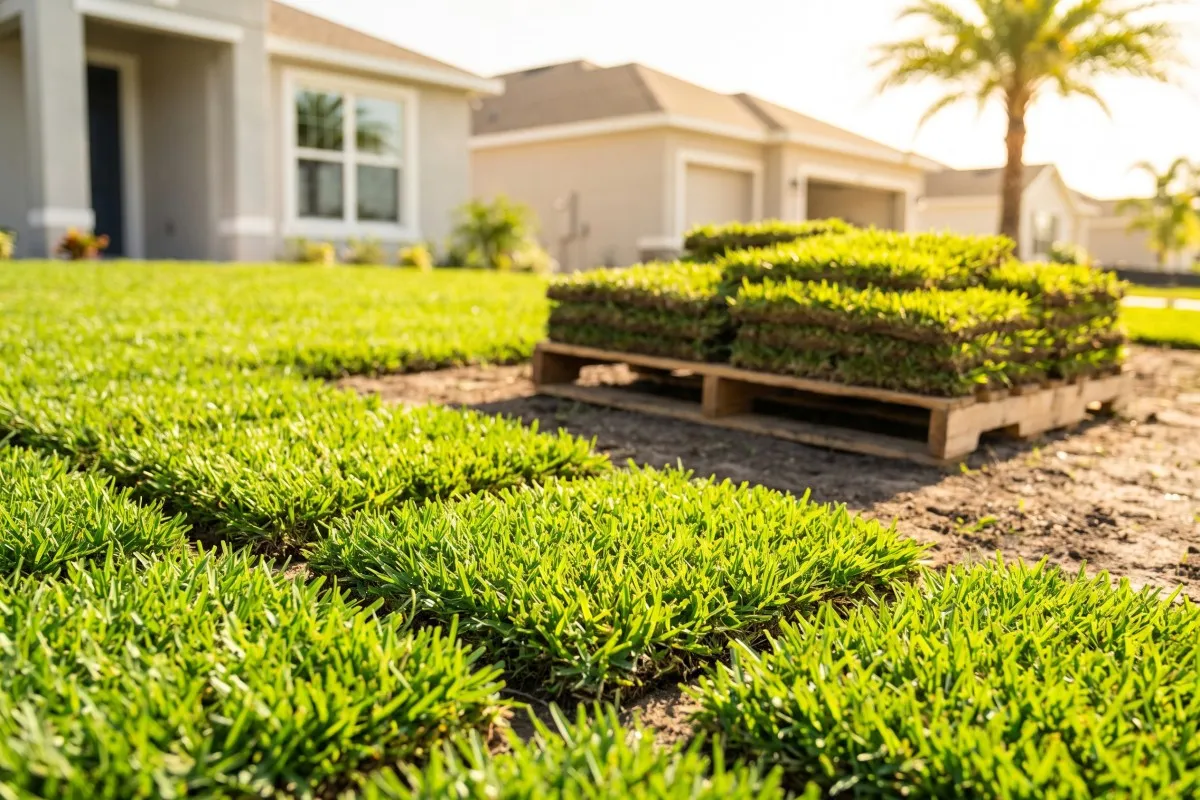
New Construction Sod Installation Tampa Bay: Builder Sod Fix
New construction sod installation in Tampa Bay done right: why builder sod fails in construction fill, and how fresh sand-bottom sod roots faster.
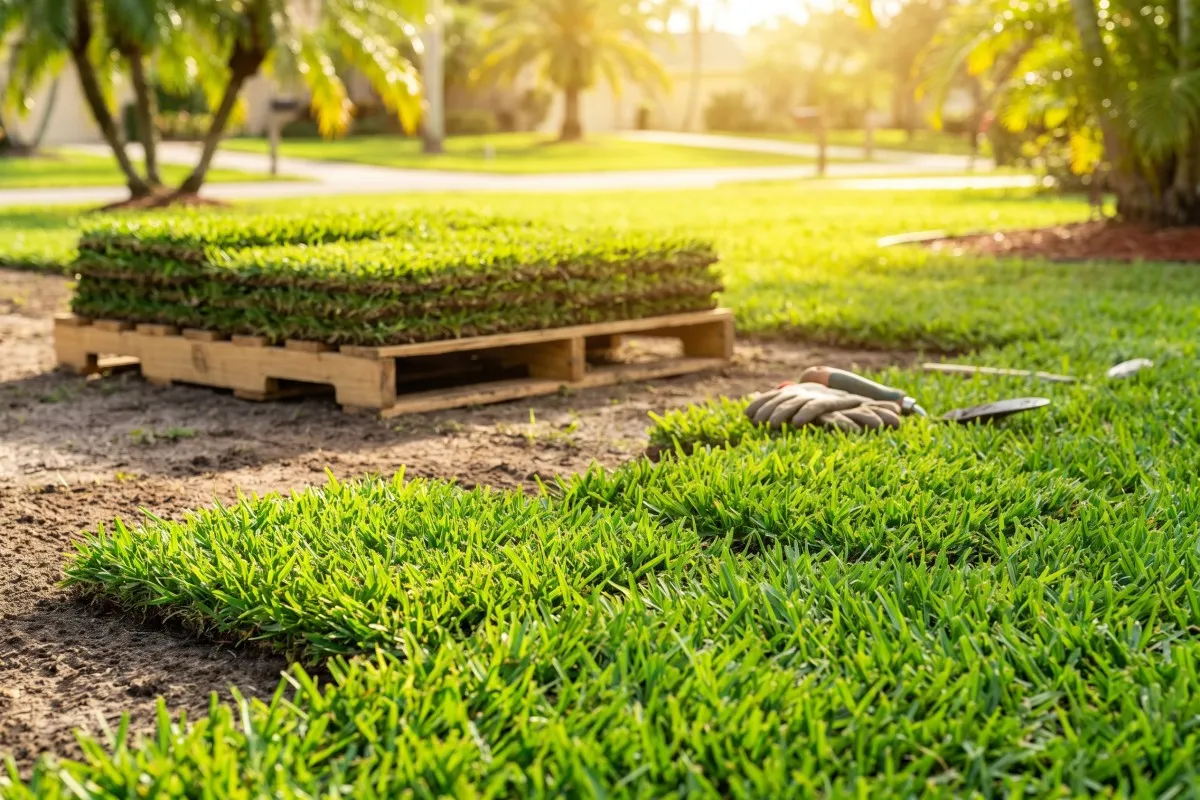
DIY Sod Installation vs. Hiring a Pro in Tampa Bay: What Florida Homeowners Should Really Know
DIY or professional sod installation in Tampa Bay? Here is the real cost, the grower's own warning, and the three prep steps that decide if sod lives.